
Blog
Research by Home Marketing Services led by Bob Lovell shows how Americans feel about AI when it comes to home buying

In March of this year it was widely reported that a Florida man used ChatGPT to sell his home and that the AI chatbot beat all real estate agent estimates by $100,000 dollars and the house sold in just 5 days. That made us here at HMS wonder, do Americans really trust AI bots to buy and sell their homes and real estate property?
Research Study: Do Americans Want to Replace Human Real Estate Agents with AI?
What do Americans think of an AI only real estate agent?
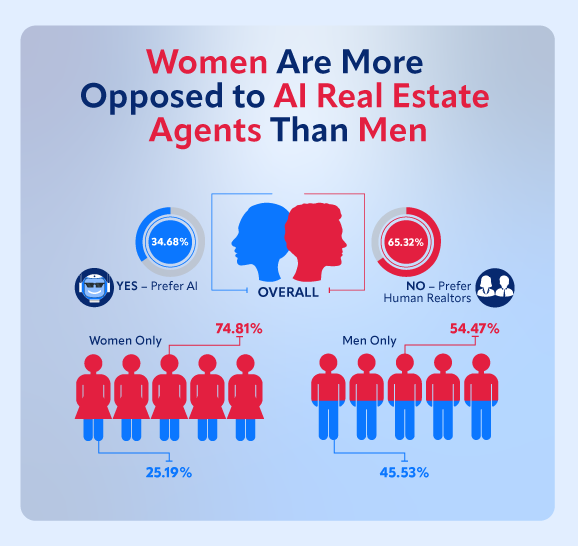
Well, we polled more than 2,100 American adults and asked them bluntly the question, should AI replace human realtors? 34.68% said "Yes" and 65.32%, a clear majority, said "No".
The reality is, that at least for the moment, Americans do not trust AI chatbots enough to buy and sell homes for them.
"In real estate being a person that your buyer or seller trusts is a big part of our job, especially for first-time homebuyers or someone who is moving a long distance to purchase a home. One wrong move and a buyer is overpaying, missing out on incentives from a home builder, or stuck with a home in bad need of repairs and sellers can lose money or get stuck in temporary homeless limbo having to rent a hotel room or make other accommodations between selling their home and buying a new one. Until AI can prove it does all of a human real estate agent's jobs and completes transactions flawlessly, those using real estate services are less likely to use such a service and our study data shows this." - Bob Lovell, HMS founder
Examining Responses by Age
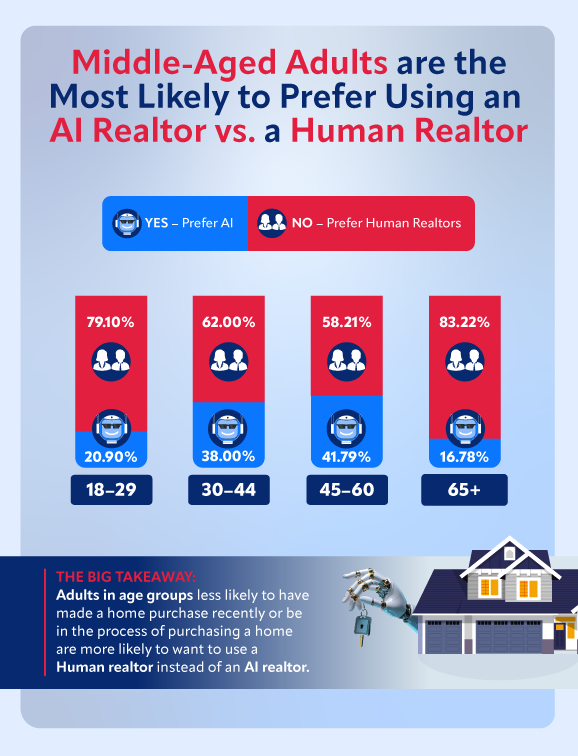
When we look at our data by age we see that senior citizens over 65 and young adults are the least likely to prefer using an AI real estate agent versus a human real estate agent. Seniors are the most against it at 83.22% saying "No" to using a real estate agent. 79.10% of young adults aged 18 to 29 also were against using Ai real estate agents.
Those more in favor tend to be middle-aged or close to it and coincidently these are in the age range of someone who might be first time homeowner. 41.79% of those aged 45-60 said they would prefer an AI real estate agent and 38.00% of those age 30-44 also said they would prefer a real estate agent that was powered by artificial intelligence.
Examining Responses by Gender
When we look at the data by gender men are nearly split 50/50. Only 54.47% of men say they do not want to us an AI real estate agent, a slim majority. When we look at women that number jumps to nearly 75% at 74.81% saying they prefer a human real estate agent.
Is there a reason for this gender gap to be so wide? It may come down to more women being involved in real estate versus men in general, though we're not entirely sure.
Examining Responses by Household Income
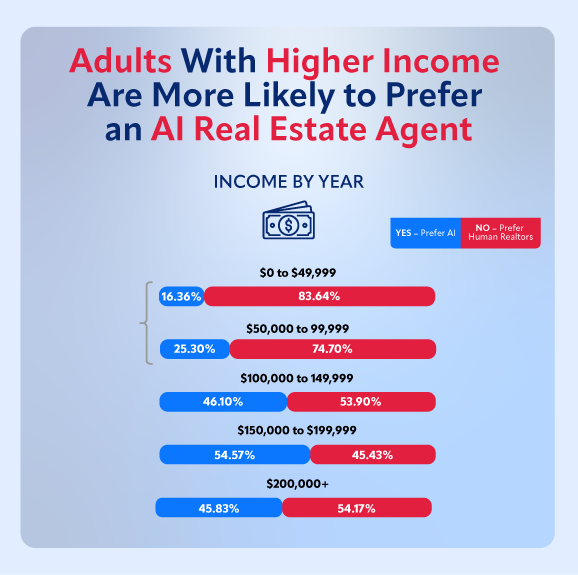
The data broken down by household income also reveals some interesting insights. In our study those who reported a higher household income were more likely to want to use an AI real estate agent vs. those with lower income. Those who reported household incomes between $150,000 and $199,000 were the most likely to prefer an AI real estate agent with the likelihood more than doubling from the income range of $50,000 to $99,000 at a 115.69% increase. Compared to the lowest income range of $0 to $49,999 the contrast increases, more than tripling at a 233.55% increase.
If AI real estate agents are the future of the profession somewhere years down the road - this might mean higher income households, which typically own more valuable homes, will be harder to land as clients for human real estate agents. This is all speculation however, things could change dramatically between now and that future point in time.
Examining Responses by USA Region
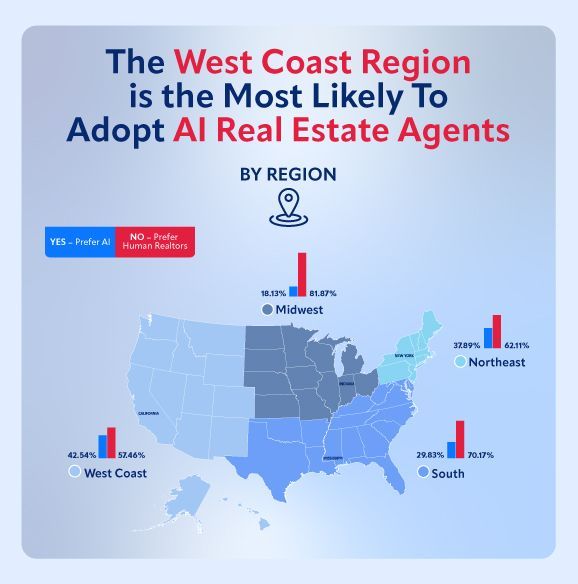
Finally, we broke the data out by region of the country to see if any parts of the nation were more likely to want to us AI for buying or selling a home than others. To produce a simpler version of the data on our map we combined states into 4 regions: Northeast, South, Midwest, and West Coast. Our grouping placed Texas in with the South, and placed Colorado, New Mexico, Arizona, Utah, Wyoming, Montana, Alaska, Hawaii, and Idaho in the with the West Coast grouping.
The Midwest was the least likely to want to use an AI real estate agent at just 18.13%, The West Coast grouping was the most likely at 42.54% reporting they would want to use an Ai service to buy or sell real estate for them.
Methodology
We polled 2,180 randomly selected participants via the internet and balanced to match the most recent census getting an even view from all parts of the USA, age ranges, gender, and household income that most closely match a representative sampling of the USA. We added screening questions to remove any potential inauthentic responses. At n = 2,180 our study has a 2.06% margin of error at 95% confidence interval.
We asked the question as specifically as possible to represent the current time period and capabilities of AI systems: "In general, Do you think AI should replace Realtors / Real Estate Agents / Brokers? (i.e. no more human real estate agents showing houses, representing buyers/sellers, and getting paid on commissions - instead all of it being done with an AI software/robot system)".
The research team was led by
Bob Lovell, a legendary real estate CEO based in Dallas, TX.



Contact HMS
Bless Your Heart – Let the team at HMS show you how you can save money by owning your home.